I took the kids to the park today and left the camera at home.
That sentence should not be remarkable. Parents go to parks without cameras all the time. But I have been photographing things — seriously, with intention, with equipment — for most of my adult life. The camera is how I process being somewhere. It is how I slow things down enough to look at them. Going somewhere without it felt, the first few minutes, like showing up to an exam without a pen. My hands didn't know what to do. I kept framing shots in my head that I wasn't taking.
Then something shifted. Around the ten-minute mark, I stopped framing and started watching. Emily was on the swings, pumping her legs with that total commitment kids have when they're trying to go higher — the whole body in it, nothing held back. Cody was in the carrier against my chest, asleep, his weight settling into me with each step. Meghan and Claire were doing something complicated and slightly dangerous on the climbing structure that I decided not to examine too closely.
I was just there. Not recording it. Not thinking about how I would remember it. Just in it, which is different, and which I had apparently forgotten how to do.
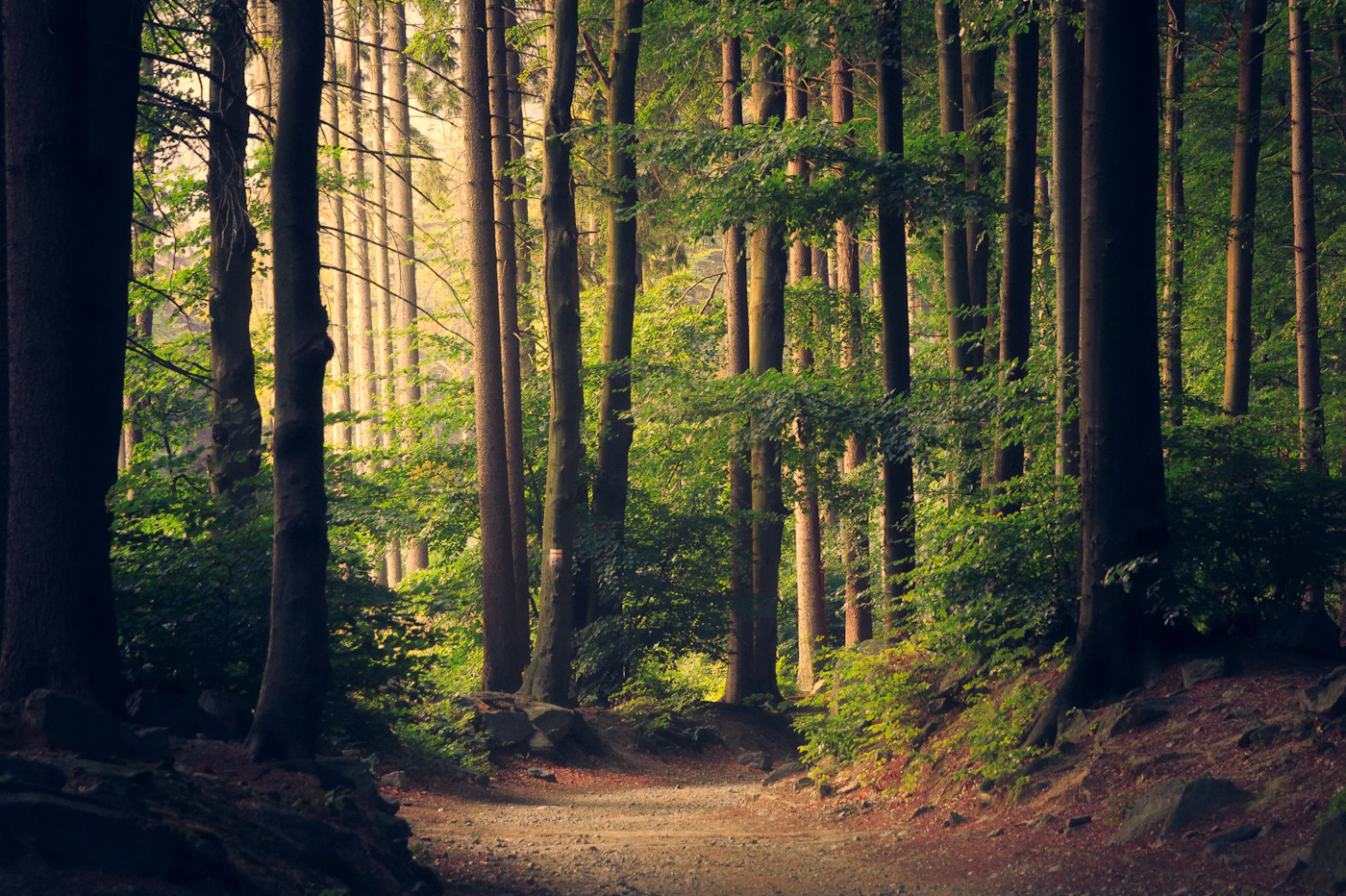
The park — not a posed shot, not a moment captured. Just what the park looks like when you're not trying to photograph it. Kids at a distance, motion blur acceptable, the light doing whatever it wants.
What Watts Actually Says About This
I have been re-reading The Wisdom of Insecurity — for maybe the fourth time, spread across several years — and each time I get something different from it. This time what I keep landing on is his description of the present moment not as a destination but as the only place anything ever actually happens.
This sounds obvious. Of course things happen in the present — where else would they happen? But Watts is making a more specific claim. He is saying that most of us are not, in any meaningful sense, living in the present. We are living in a running mental commentary about the present — a layer of interpretation and evaluation that runs about half a second behind reality, labeling and filing and planning, so that by the time you consciously register what just happened, what just happened is already gone.
The commentary is not bad, exactly. You need it. It is how you navigate, plan, communicate. The problem is when the commentary becomes the primary experience — when you are more inside your own narration of life than inside life itself. That is when things start to feel thin. That is the specific feeling Watts is diagnosing when he talks about insecurity: not the fear of particular bad outcomes, but the background hum of dissatisfaction that comes from being perpetually adjacent to your own experience rather than in it.
The Camera Was a Stand-In
I want to be careful here, because I am not making an argument against photography. Photography at its best is a form of presence — you have to actually see something to photograph it well, and learning to photograph well is, in part, learning to see. The ten years I spent shooting weddings trained my attention in ways I am still drawing on.
But there is another way to use a camera, and I had slipped into it: using it as a buffer. The camera between you and the moment creates a certain comfortable distance. You are technically there — you are at the park, you are at the birthday party, you are on the trip — but you are also slightly behind glass, processing the experience into images rather than living inside it. The record becomes more real than the thing being recorded.
Watts has a name for this too. He calls it the confusion of the map with the territory — treating the symbol or the description of an experience as if it were the experience itself.1 A photograph of your child laughing is a symbol of the moment. The moment was your child laughing, which is a thing that happened in time and is gone now, and the photograph points at it but is not it. When you spend the moment taking the photograph, you have prioritized the symbol over the thing. This is very easy to do and very hard to notice until you've done it enough times that the moments themselves start to feel like raw material for documentation rather than the whole point.
Emily on the swings — or a child on swings, caught in motion, shot carelessly. Not a portfolio shot. Just what it looked like.
Trying to Be Present Is Still Trying
Here is the part that gets tricky, and it is the part Watts is most honest about.
At the park, once I realized what I was missing by framing everything, I made a conscious decision to be present. To really be there. To attend. And for a few minutes I was doing this quite effortfully — checking in with myself, am I present now? Is this presence? Am I doing it? — which is, of course, exactly the same problem in a different form. I had just replaced camera-management with presence-management. Still performing. Still adjacent. Still watching myself instead of watching the kids.
This is the core of what Watts is saying when he talks about the impossibility of forcing the present moment. Presence is not a thing you can aim at and hit. The effort to be present is itself a form of absence — you are thinking about being present instead of being present, which means you are not present. It is the same structure as trying to fall asleep. The trying is the problem.
What actually happened at the park — the real shift, around the ten-minute mark — was not that I tried harder or succeeded at presence. It was that I forgot to keep trying. Cody's weight in the carrier, Emily's laugh from across the playground, the specific quality of afternoon light through the trees — these things came in when I stopped managing the gate. The moment let itself in. I did not let it in. That distinction is what Watts spends three hundred pages explaining and what I keep having to relearn in smaller and smaller situations.
What I Took Home
I did not take any photographs. I have no record of the afternoon except what is in my memory, which is already softening at the edges the way memories do. By next month it will probably be a general impression rather than a specific afternoon. By next year it may be gone.
I find I am mostly okay with that. More than okay, actually — there is something that feels like the right proportion in it. The afternoon was for the afternoon. It was not for the archive.
Watts writes that life is not a problem to be solved but an experience to be had.2 I read that sentence every time I pick up this book and every time it lands slightly differently. Today it landed as: the kids are not a project. The park was not an opportunity. The afternoon was the thing itself, complete in itself, needing nothing added to it — not documentation, not optimization, not the running narration of a man who has read too much philosophy and keeps checking whether he is applying it correctly.
He would find that last part funny. He would probably say that's the point.
- Alan Watts, The Way of Zen (Pantheon Books, 1957), Part One, Chapter 1. Watts draws on Alfred Korzybski's distinction between the map and the territory throughout his work, but his clearest treatment of how this applies to experience — and specifically to the confusion of memory and anticipation with actual living — is in The Wisdom of Insecurity (1951), Chapters 4 and 5. ↩
- This formulation appears across multiple Watts texts and lectures; the clearest written version is in The Wisdom of Insecurity, Chapter 3. Watts is adapting a theme common to both Zen and Taoist thought: that the goal of life is not somewhere ahead of where you are, requiring achievement, but present in the act of living itself. ↩
Citations assisted by AI. I've done the reading. I have not memorized the copyright pages.